Making a non-fiction book personal and engaging involves several strategies to connect with readers on a deeper level and draw them into the narrative. By connecting with readers on a personal level, you can create a meaningful and memorable reading experience that resonates long after they’ve finished the book.
Here are some techniques to consider:
Share Personal Stories and Anecdotes: Incorporate personal anecdotes, experiences, and stories into the narrative to make it relatable and authentic. By sharing your own journey, struggles, and triumphs, you can establish a connection with readers and provide real-life examples that illustrate key concepts or themes. This will inspire them to apply the book’s principles to their own lives.
Clarify and Strengthen the Thesis: Ensure that the book’s main thesis or central argument is clear, compelling, and well-supported throughout the text. Clarify the purpose of the book and the key message you want to convey to readers. Consider whether the thesis needs to be refined or expanded to provide greater depth and insight into the subject matter.
Add Depth Through Research and Analysis: Conduct additional research to add depth and context to the book’s content. Incorporate insights from theological, historical, and philosophical sources to provide a richer understanding of the subject matter. Analyze key concepts, scriptures, and theological arguments in greater detail, offering readers new perspectives and insights that they may not have considered before.
Use Conversational Tone and Language: Write in a conversational tone that feels natural and approachable to readers. Use language that is clear, concise, and engaging, avoiding overly technical or academic terminology. Imagine you are having a conversation with a friend, and strive to maintain a friendly and accessible tone throughout the book.
Address the Reader Directly: Break the fourth wall by addressing the reader directly and inviting them to participate in the conversation. Use second-person pronouns (“you”) to engage readers and encourage them to reflect on their own experiences, beliefs, and perspectives. Encourage reader involvement through questions, prompts, and exercises that encourage self-reflection and interaction.
Create Vivid Descriptions and Scenes to Engage the Senses: Use descriptive language to paint vivid images and scenes that bring the subject matter to life and create a more immersive reading experience. Engage the reader’s senses by appealing to sight, sound, smell, taste, and touch, immersing them in the world you are describing. Use storytelling techniques such as dialogue, anecdotes, action, and scene-setting to create dynamic and memorable narratives.
Show Empathy and Understanding: Demonstrate empathy and understanding towards your readers by acknowledging their feelings, concerns, and challenges. Validate their experiences and emotions, and offer practical advice, insights, and solutions that address their needs and aspirations. Show that you are invested in their journey and committed to supporting them every step of the way.
Use Humor and Wit: Inject humor, wit, and personality into your writing to keep readers engaged and entertained. Use anecdotes, jokes, and humorous observations to lighten the mood and break up dense or complex information. However, be mindful of the tone and context, and avoid using humor that may alienate or offend readers.
Provide Personal Reflections and Insights: Share your own reflections, insights, and lessons learned throughout the book. Be transparent about your own successes and failures, and offer valuable takeaways that readers can apply to their own lives. By sharing your personal wisdom and perspective, you can inspire and empower readers to make positive changes and pursue their goals.
Include questions for reflection, journaling prompts, and practical exercises throughout the book to encourage readers to engage with the material on a deeper level. Encourage readers to apply the book’s principles to their own lives, relationships, and spiritual journeys, providing guidance and support as they seek to grow in faith and discipleship.
Seek Feedback and Revision: Seek feedback from beta readers, editors, and trusted advisors to identify areas for improvement and refinement. Be open to constructive criticism and willing to revise and rework sections of the book as needed to enhance clarity, coherence, and effectiveness. Continuously strive to improve the book’s content, structure, and presentation to better serve the needs and interests of readers.
By implementing these strategies, you can transform a flat non-fiction Christian book into a more engaging, impactful, and transformative reading experience that resonates with readers and leaves a lasting impression on their hearts and minds.
Why is Sharing Personal Stories and Anecdotes Important?
Incorporating personal stories and anecdotes into a non-fiction narrative enhances its authenticity, relatability, and engagement, making it more impactful and memorable for readers.
By sharing their own experiences and insights, authors can connect with readers on a deeper level and inspire them to create positive change in their own lives.
Here are some reasons why:
Establishing Authenticity: Personal stories add authenticity to the narrative by demonstrating that the author has firsthand experience with the subject matter. Readers are more likely to trust and connect with an author who shares their own experiences and perspectives.
Creating Relatability: Personal anecdotes make the content relatable to readers by showing that they are not alone in their struggles, challenges, and triumphs. When readers see themselves reflected in the author’s stories, they feel understood and validated, fostering a sense of empathy and connection.
Illustrating Key Concepts: Personal stories serve as concrete examples that illustrate abstract concepts or themes discussed in the book. By providing real-life scenarios and experiences, authors can clarify complex ideas and make them more accessible and understandable to readers.
Engaging Readers: Personal anecdotes capture readers’ attention and draw them into the narrative by adding depth, emotion, and human interest. Readers are more likely to be engaged and invested in a book that includes compelling stories and anecdotes that resonate with their own experiences.
Inspiring and Motivating: Personal stories have the power to inspire and motivate readers by showcasing the author’s journey of growth, transformation, and resilience. When readers see how the author overcame obstacles and achieved success, they are encouraged to take action and pursue their own goals and aspirations.

Training by: Dr. Muthoni Mercy Omukhango
What You Are Learning
When you write non-fiction Christian books, you are not just passing information. You are helping the reader believe, feel, and remember. One of the strongest ways to do that is to use a real personal story.
A good personal story does four things:
- it introduces a real moment
- it reveals your inner struggle
- it connects that moment to a spiritual truth
- it leaves the reader with a lesson

What to focus on
At some points, the storytelling is strongest when the story remains close to the lesson. Where the narrative stays vivid and then quickly returns to meaning, it is especially effective.
That is the sweet spot you should aim for: not testimony for testimony’s sake, but testimony in service of truth.
“A personal story is not there to make readers admire you. It is there to help them understand the truth. In Jesus Killed My Business, here are the examples:
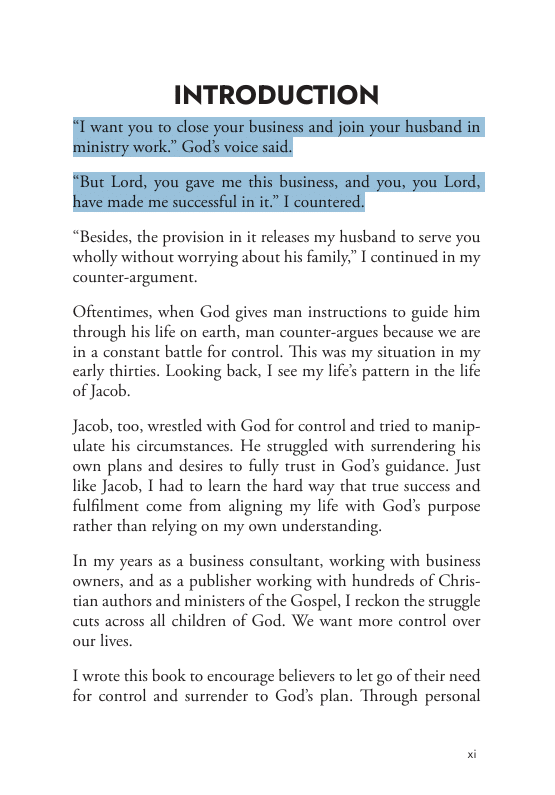
Example 1: Use a personal moment to teach surrender
Main concept being taught
You must surrender control to God.
Actual excerpt
“I want you to close your business and join your husband in ministry work.”
“But Lord, you gave me this business…”
What you should notice
Instead of beginning with a general statement such as You must surrender to God, the writer begins with a live moment of tension. You hear God’s instruction. You hear the resistance. You immediately feel the struggle.
What this teaches you
When you want to teach surrender, do not begin with a sermon sentence. Begin with the moment when surrender became difficult for you.
Writing lesson
You make truth stronger when you let the reader overhear the struggle.
Writer’s takeaway
Ask yourself: What real conversation, prayer, disappointment, or inner argument helped you understand this truth?
Example 2: Use a personal experience to teach calling
Main concept being taught
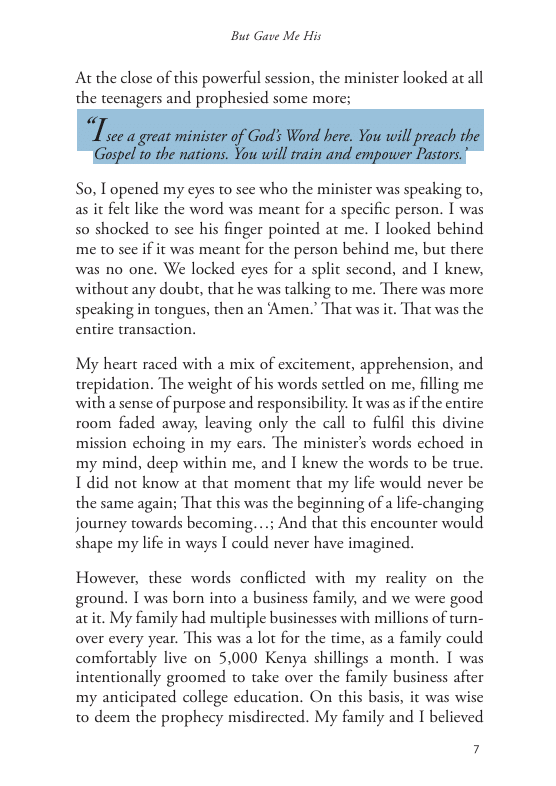
God can call you long before you understand your future.
Actual excerpt
“I see a great minister of God’s Word here. You will preach the Gospel to the nations. You will train and empower Pastors.”
Follow-up excerpt
“I was so shocked to see his finger pointed at me.”
What you should notice
The writer does not merely say, God called me when I was young. She places you inside the revival meeting. You see the minister. You hear the prophecy. You feel the shock.
What this teaches you
If you want your reader to understand calling, you should not explain it only in theory. You should place the reader inside the moment when calling interrupted your normal life.
Writing lesson
A concept becomes memorable when you attach it to a scene.
Writer’s takeaway
Instead of writing:
God called me when I was young.
Write something more like:
At a prayer meeting, camp, church service, school assembly, or quiet prayer time, something happened that made you realise God was speaking.
Example 3: Use inner conflict to teach spiritual hunger
Main concept being taught
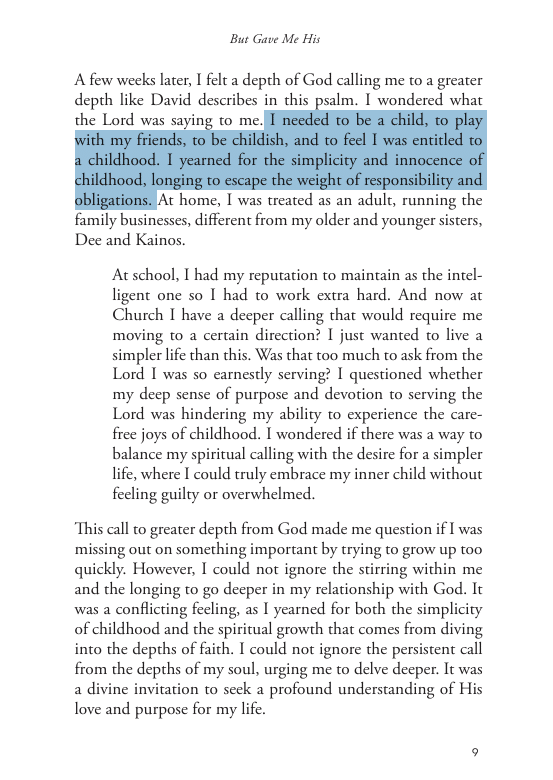
A deeper walk with God often comes with inner tension.
Actual excerpt
“I needed to be a child, to play with my friends, to be childish…”
Follow-up excerpt
“I just wanted to live a simpler life than this.”
What you should notice
The writer does not present spiritual hunger as neat or polished. She shows you the conflict: wanting God, yet also wanting ease, freedom, and simplicity.
What this teaches you
When you teach a spiritual truth, you should not remove the human struggle. Often the struggle is the doorway into the lesson.
Writing lesson
Your writing becomes deeper when you admit what you were feeling, not only what you believed.
Writer’s takeaway
If you are teaching about prayer, obedience, patience, purity, waiting, forgiveness, or faith, ask:
What did this truth feel like inside me while I was learning it?
Example 4: Use curiosity and lived detail to teach spiritual awakening
Main concept being taught
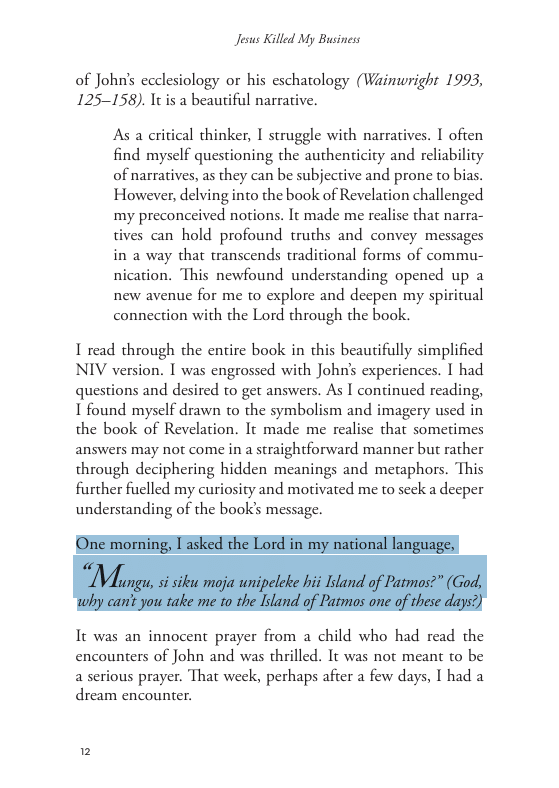
God can use ordinary moments to awaken deeper spiritual understanding.
Actual excerpt
“God, why can’t you take me to the Island of Patmos one of these days?”
Follow-up excerpt
“I was shocked and thrilled at the same time.”
What you should notice
The writer gives you a childlike prayer, then a strange and powerful experience. That movement from curiosity to encounter gives the lesson life.
What this teaches you
If you want to teach that God meets hungry hearts, do not only say it. Show the question, the longing, the event, and the emotional response.
Writing lesson
Sometimes the small question is what opens the door to the big lesson.
Writer’s takeaway
Do not ignore simple moments in your life. A small prayer, a short conversation, a dream, a sentence from Scripture, or a quiet nudge may carry a large lesson.
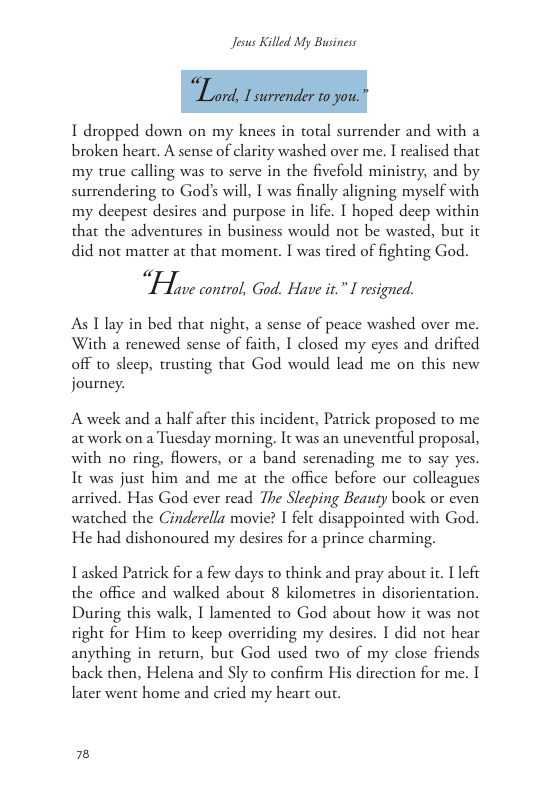
Example 5: Use personal misdirection to teach that purpose is not always straight
Main concept being taught
What seems right to you may still lead you away from God’s true path.
Actual excerpt
“I was going to take it by force.”
Follow-up excerpt
“There is a way which seems right to a man…”
What you should notice
The writer explains that the business path looked wise, impressive, and fitting. That is what makes the lesson powerful. The wrong direction did not look evil. It looked reasonable.
What this teaches you
You teach more effectively when you show how you were convinced by the wrong thing.
Writing lesson
A personal story is strong when it includes honest self-deception, not only obvious failure.
Writer’s takeaway
If you are teaching discernment, obedience, or purpose, do not only write about big sins. You may teach just as powerfully through a path that looked good, sensible, and godly, yet was not God’s will for you.
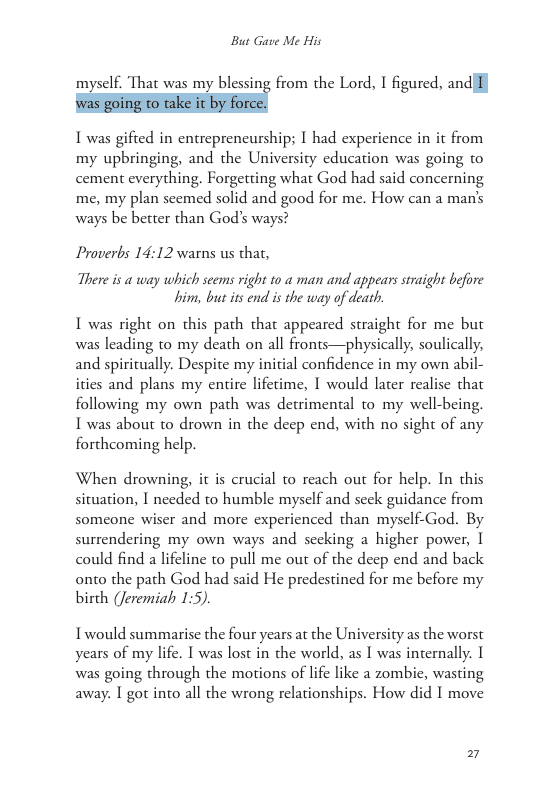
Example 6: Use your pain honestly to teach the power of company
Main concept being taught
The people around you shape your direction.
Actual excerpt
“My greatest undoing was the company I kept.”
What you should notice
That line is strong because it is direct, personal, and accountable. The writer does not hide behind vague language.
What this teaches you
When you write non-fiction, honesty gives your teaching authority. Readers trust you more when you admit what truly weakened you.
Writing lesson
You do not have to sound perfect to sound wise.
Writer’s takeaway
If you are teaching about friendship, influence, distraction, or compromise, ask:
What relationship, group, or environment exposed this truth in my life?
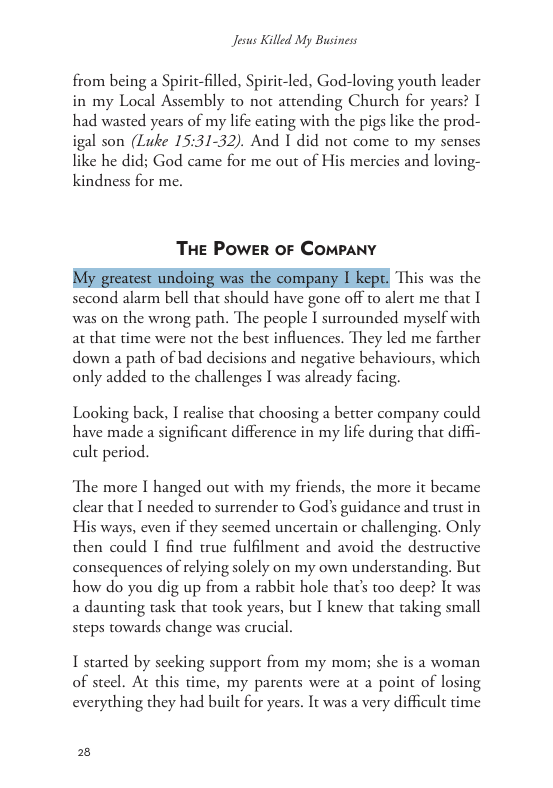
Example 7: Use the turning point to teach surrender
Main concept being taught
Real surrender has a before and after.
Actual excerpt
“Lord, I surrender to you.”
Follow-up excerpt
“I was tired of fighting God.”
What you should notice
This is effective because the surrender comes after a long struggle. The line is simple, but it carries weight because the story has prepared you for it.
What this teaches you
Sometimes the most powerful sentence in your story is not the longest one. It is the one that marks change.
Writing lesson
Do not rush past the turning point. Let the reader feel its cost.
Writer’s takeaway
In your own writing, identify the sentence that marks change:
- the prayer
- the confession
- the decision
- the repentance
- the breakthrough
That sentence often carries the whole lesson.
Lessons from These Examples
From these excerpts, you can see that when you teach through personal story, you should include the following:
1. A real moment
You need a scene, not just an idea.
2. A real feeling
You need fear, shock, confusion, longing, resistance, shame, hope, or joy.
3. A real conflict
You need something at stake.
4. A spiritual interpretation
You must show what God was teaching you through that moment.
5. A clear lesson for the reader
You must help the reader move from your story to their understanding.
Conclusion
When you write non-fiction Christian books, do not hide behind explanation alone. If you want your reader to understand surrender, show the place where you resisted God. If you want your reader to understand calling, show the moment when God interrupted your plans. If you want your reader to understand spiritual hunger, show the tension inside you. Personal story is not decoration. It is one of the ways truth becomes unforgettable. The model text shows you that spiritual concepts become stronger when they are carried by human moments.
(Guided Practice) Exercise A: Spot the structure
For each excerpt above, identify:
- What is the main concept?
- What is the story moment?
- What emotion is present?
- What spiritual lesson comes from it?
Exercise B: Turn a flat sentence into a teaching story
Flat sentence
God taught me to trust Him.
Your task
Rewrite it by answering:
- Where were you?
- What had gone wrong?
- What were you feeling?
- What did you say to God?
- What changed?
Possible answer using Jesus Killed My Business as the model:
Possible Answer
1. Flat version
God taught me to trust Him.
Why it is flat
This tells the lesson, but it does not help you see it, feel it, or understand how it was learnt. It gives you the conclusion without the journey.
2. Improved version
I was at a point in my life where I thought business was my future and that I understood exactly where I was going. Then God began to challenge that plan and lead me in a different direction. What went wrong was that the path I trusted most was not the path God wanted for me. I felt afraid, disappointed, and confused because I did not want to lose control of my future. I questioned God and struggled to understand why He would ask me to release something that seemed good and successful. But through that painful season, I learnt that trusting God means believing Him even when His instructions do not match your plans. In the end, what changed was my heart. I stopped clinging so tightly to my own ideas and began to surrender to His will. That was how God taught me to trust Him.
Why it is better
This version is stronger because it gives:
- a real situation
- emotional struggle
- tension between personal plans and God’s will
- a clear spiritual lesson
But it still explains more than it shows.
3. Strong show-don’t-tell version
I had arranged my future so neatly in my mind that it felt almost visible. Business was the road ahead of me—broad, paved, familiar. I could already hear the language of progress: strategy, growth, management, success. It fit my background. It fit my gifts. It fit the story I had been telling myself for years. I did not feel lost. I felt prepared.
So when God began to point me in another direction, I did not welcome it with open hands. I held my plans closer.
Inside me, questions rose like a protest. Lord, why this? Why now? Why ask me to release something that seems useful, productive, and even blessed? I looked at the path I had chosen and saw sense. I looked at God’s interruption and saw uncertainty. My future had felt like a house I had carefully built brick by brick, and now it seemed the Lord was asking me to walk out of it before I had another shelter in sight.
Fear sat heavily in me. Not loud fear, perhaps, but the kind that tightens your chest and makes you rehearse your arguments again and again. I was afraid of losing direction. Afraid of losing security. Afraid of becoming the kind of person who had no neat answer when people asked, “So what next?” More than that, I was afraid of handing over control. I wanted God to bless my path, not redraw it.
But the more I wrestled, the more He showed me that what I called trust had often depended on visibility. As long as I could understand the route, calculate the cost, and explain the outcome, I felt steady. Yet when He led me where my reasoning could not comfortably follow, I discovered how thin my confidence really was.
That season stripped me. It pulled away the illusion that faith must always feel clear. It taught me that obedience often begins while your questions are still unanswered. Slowly, my resistance began to weaken. The future I had clung to so fiercely no longer looked like safety; it looked like self-will dressed in sensible clothing.
And so my heart changed before my circumstances did. The clenched fist loosened. The arguments quietened. The need to have everything explained began to bow under a greater need—to be led by God, even when His voice took me where my plans had not.
That was how God taught me to trust Him.
What changed from one version to the next?
1. The flat version gives only the conclusion
“God taught me to trust Him.”
You know the lesson, but you do not know:
- where it happened
- what it cost
- what was felt
- what had to be surrendered
2. The improved version gives explanation
This version helps because it names:
- the situation
- the conflict
- the emotion
- the outcome
But it still stays mostly at summary level.
3. The strong version gives experience
This version shows the lesson through:
- imagery: “road ahead,” “house I had carefully built”
- inner dialogue: “Lord, why this?”
- bodily emotion: “tightens your chest”
- contrast: “I wanted God to bless my path, not redraw it”
- transformation: “The clenched fist loosened”
Now the reader does not only understand trust. The reader feels the struggle of learning it.
Learning Point
When you write a teaching story, do not rush to the lesson. Let the reader first see your world, hear your questions, and feel your resistance. A flat sentence gives the truth. A developed paragraph gives the journey. A strong show-don’t-tell paragraph gives the truth through the journey.
Quick breakdown of the strong version
Where was the author?
She was standing in a season where business felt like her clear future.
What had gone wrong?
God was redirecting her away from the path that felt safe and sensible.
What was she feeling?
Fear, resistance, confusion, and loss of control.
What did she say to God?
“Lord, why this? Why now?”
What changed?
Her heart softened. She stopped demanding full explanation and began to surrender.
Conclusion
Tell:
I was afraid.
Show:
Fear sat heavily in me, the kind that tightens your chest and makes you rehearse your arguments again and again.
Tell:
I did not want to let go.
Show:
I held my plans closer.
Tell:
I trusted my own understanding.
Show:
As long as I could understand the route, calculate the cost, and explain the outcome, I felt steady.
Tell:
I surrendered.
Show:
The clenched fist loosened. The arguments quietened.
Exercise C: Your own paragraph
Write one paragraph beginning with this line:
There was a moment when I realised…
Then continue by showing:
- the situation
- your emotional response
- the lesson God was teaching you
Simple Writing Framework for Writers
Use this whenever you want to teach a main concept through personal story:
Your concept
What truth are you teaching?
Your story
What happened to you?
Your feeling
What were you struggling with inside?
Your lesson
What did God show you?
Your reader application
What should the reader now understand or do?
Getting Started: Publishing Books
Preparing to Write/Publish
No posts found!
Elementary Skills: Publishing Books
How to Write
No posts found!
Technical Skills: Publishing Books
Refining Your Manuscript
No posts found!
Advanced Skills: Publishing Books
Going the Extra Mile
No posts found!
Contractual Skills: Publishing Books
Be Informed (Not Legal Advice)
No posts found!