Introduction to Pre-Writing
Stages in the Writing Process
As a Christian writer, the foundation of your writing should not merely be what you are writing or whom you are writing for. The foundational principle is that you are writing as an act of worship to God and as a service to the men and women He has called you to reach.
You must rely on the inspiration and guidance of the Holy Spirit so that your message reflects what God wants your readers to hear, according to His will. This does not mean that planning, research, discipline and skill are unnecessary. Rather, it means that all these must be submitted to God and used faithfully for His purposes.
Your primary motivation should also not be monetary gain. You may sell your books and earn an income from your writing—some authors will earn more than others—but money should not be the reason you write. Income may be one of the fruits of faithful writing, but it should never become its foundation.
Watch the introductory video:
There are three main stages in the writing process:
- Pre-writing
- Drafting—the actual writing
- Revising—reviewing and editing
Stage One: Pre-Writing
The Bible teaches us the importance of counting the cost before beginning a major undertaking. Before going to war or constructing a building, a wise person first sits down and plans.
“Suppose one of you wants to build a tower. Won’t you first sit down and estimate the cost to see if you have enough money to complete it?”
—Luke 14:28
Proper planning gives you a better chance of succeeding. As a writer, you must plan and prepare before you begin writing so that you can accomplish what is required within the timelines you have set.
To get started, you need to think through several important elements of your book. We will use a real example to help us understand these elements more clearly.
Case Study
Muthoni Omukhango’s book:
Back on My Feet: The “How-To” Manual for Single Parents
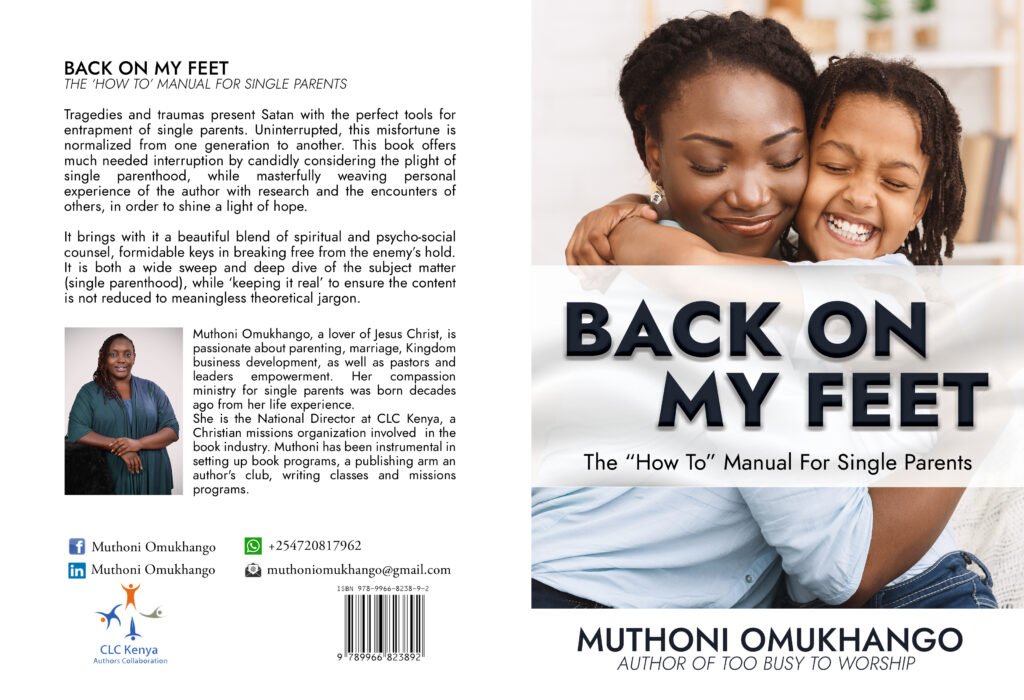
1. Determine the Subject of the Book or Content
The subject matter of this book is help for single mothers and fathers.
The subject is not necessarily the same as the title of the book. The title is the name given to the book, while the subject matter is the central issue the book discusses. It is the broad theme around which your message is built.
For example, the title of this book is Back on My Feet, but its subject is rebuilding life and parenting well as a single parent.
Before you begin writing, you should be able to state your subject clearly. Ask yourself:
What is this book really about?
Your answer should be simple enough to express in one clear sentence.
2. Define the Purpose of the Book’s Message
The purpose is the why behind the book. It explains what the author hopes the book will accomplish in the lives of its readers.
The purpose of Back on My Feet is to provide helpful information, practical guidance and encouragement to men and women navigating single parenthood. People may become single parents for various reasons, including the death of a spouse, divorce, separation, pregnancy outside marriage, abandonment, sexual violence or other difficult circumstances.
A clearly defined purpose keeps you on track while drafting your manuscript. It helps you decide what belongs in the book and what does not.
Whenever you are tempted to wander into unrelated subjects, return to your purpose and ask:
- Does this section help me fulfil the purpose of the book?
- Will this information help the reader?
- Does it strengthen or distract from the central message?
Your purpose becomes the compass that keeps your manuscript moving in the right direction.
3. Identify Your Target Audience
Who are you writing the book for?
Identifying your target audience will help you shape your tone, voice, examples, vocabulary and level of language.
For Back on My Feet, the target audience is single mothers and fathers who may already be facing discouragement, loneliness, uncertainty or emotional exhaustion. The tone must therefore be compassionate, encouraging, practical and hopeful. The author’s words should not add condemnation or discouragement to a reader who is already carrying a heavy burden.
Your audience affects how you communicate.
For example:
- Books for children should use clear, age-appropriate language and relatable illustrations.
- Books for teenagers should be honest, engaging and respectful of their experiences.
- Books for parents may need a warm, practical and reassuring tone.
- Books for businesspeople and leaders may require a professional, structured and solution-focused approach.
- Books addressing grief, trauma or family challenges should be written with sensitivity and compassion.
However, avoid assuming that every woman, man, child or teenager thinks and responds in exactly the same way. Write for real people, not stereotypes. Your reader should feel understood, respected and valued.
Deciding on your target audience at the beginning will also reduce unnecessary back-and-forth communication with editors later in the publishing process.
Ask yourself:
- Who needs this message most?
- What is the reader currently experiencing?
- What questions are they likely to have?
- What tone will help them receive the message?
- What level of language will be appropriate for them?
You may have many people who could benefit from your book, but you should identify the primary reader you are addressing.
4. Set a Writing Timetable
Human beings are creatures of habit. Establishing a regular writing routine may not be easy at the beginning, but once you become accustomed to it, your body and mind will begin to recognise that it is time to write. Your spirit, too, becomes more attentive to the discipline—well, almost every time!
I often write better at night when there are fewer distractions. My timetable may look like this: after dinner, I settle the children for the night and then write for one or two hours. I repeat this consistently over a period of several weeks until I reach my writing goal.
So, what is the best time to write?
The best time is the time you deliberately set aside and faithfully protect.
Some authors write early in the morning before the rest of the household wakes up. Others write during their lunch break, late at night or on particular days of the week. The exact time is not as important as your commitment to it.
You may also wonder whether it is better to write for a few minutes every day or dedicate one or two full days each week to writing. Writing for a short period every day can help you build consistency and maintain momentum. However, the best routine is the one that works realistically for you.
The secret is not in copying another author’s timetable. The secret is in choosing a routine and remaining disciplined enough to follow it.
When developing your writing timetable, consider:
- the total number of words or chapters you need to write;
- the date by which you want to complete the manuscript;
- the number of writing days available to you;
- your family, ministry and work responsibilities; and
- the amount of writing you can realistically complete in each session.
Do not merely say, “I will write when I have time.” Time rarely volunteers itself. You must give your writing a place in your calendar.
5. Choose a Writing Space
Many renowned authors confirm that having a designated writing space helps them concentrate and allows their words to flow more freely. Some compare the importance of a suitable writing space for an author to the importance of proper shoes for an athlete.
The space does not have to be large, expensive or impressive. It simply needs to help you focus.
For some authors, natural light is an important enabler. A desk near a window, a balcony, a veranda or an outdoor bench may provide the right atmosphere. Others work better in a quiet, enclosed room. Some find inspiration in a café, a library, a garden, near the beach or surrounded by nature.
Whatever works for you, identify a space in your home, office or another suitable location that supports your writing.
Your writing space should, as far as possible:
- reduce unnecessary distractions;
- provide a comfortable place to sit and work;
- give you access to the materials you need;
- allow you to think, pray and concentrate; and
- signal to your mind that it is time to write.
You may not always have perfect writing conditions. There will be interruptions, noise, responsibilities and days when inspiration seems to have taken leave without permission. Nevertheless, a consistent writing space can make it easier for you to settle down and begin.
Ultimately, the goal is not to wait for the perfect atmosphere. It is to create an environment that helps you remain faithful to the writing assignment God has placed in your hands.
Build a Strong Foundation for Your Book
Before you begin drafting, clarify what your book is about, why it needs to be written, whom it is meant to serve, when you will write it and where you will do the work. These decisions give your manuscript direction and help you remain faithful to the writing assignment God has placed in your hands.
By the end of this session, you should have defined your book’s subject, purpose and primary audience, and created a realistic writing timetable and suitable writing space.
Determine the Subject of the Book or Content
For example, the title Back on My Feet is not itself the subject. Its subject is rebuilding life and parenting well as a single parent. The book offers help to single mothers and fathers. Before writing, you should be able to answer one simple question: What is this book really about?
Define the Purpose of the Book’s Message
The purpose of Back on My Feet is to provide helpful information, practical guidance and encouragement to people navigating single parenthood through bereavement, divorce, separation, abandonment, pregnancy outside marriage, sexual violence or other difficult circumstances. A clear purpose becomes the compass that keeps your manuscript moving in the right direction.
Test Every Section Against the Purpose
Does this section help fulfil the purpose of the book?
Will this information genuinely help the reader?
Does it strengthen or distract from the central message?
Identify Your Target Audience
The primary readers of Back on My Feet are single mothers and fathers who may be facing discouragement, loneliness, uncertainty or emotional exhaustion. The tone must therefore be compassionate, practical, hopeful and free from condemnation.
Set a Writing Timetable
Some authors write early in the morning, others during lunch breaks, at night or on set days of the week. The secret is not copying another writer’s timetable. It is choosing a realistic routine and following it consistently.
Choose a Writing Space
A desk near a window, a quiet room, a veranda, café, library, garden or outdoor bench may work. Perfect conditions are rare. Create an environment that reduces distractions and signals to your mind that it is time to write—even when inspiration has taken leave without permission.
Clarity Supports Faithful Writing
Know what you are writing, why you are writing it, whom you are serving, when you will write and where you will do the work. Planning does not replace dependence on God; it helps you steward the message and assignment He has entrusted to you.
Save a Copy of Your Work
Download the completed training worksheet before leaving or refreshing the page (on computer only ie not on mobile phone).
Printing opens a new browser window. Please allow pop-ups for this website when prompted.

Training by: Dr. Muthoni Mercy Omukhango
Dr. Muthoni Mercy Omukhango is a Christian publisher, author, trainer, and marketplace minister. She serves as National Director of CLC Kenya, Authors’ Manager at the African Christian Authors Book Award (ACABA), Convener of Mama Africa Book Box, and Patron of CLC Kids and Teens.
Through the Publishing in Africa Series, she equips authors, publishers, and literary entrepreneurs with practical strategies for developing, publishing, distributing, and growing African-authored literature.
Her ministry is centred on advancing God’s Kingdom through literature and helping more African voices to be written, published, distributed, and read.
Stages in the Writing Process
Write Your Book
Introduction to Pre-Writing (Stages In The Writing Process)
Learn the essential stages of the writing process, beginning with pre-writing. This practical Christian writing resource guides authors in defining their subject, purpose, target audience, writing timetable and ideal writing...
Read More