Group Writing Mentorship Class
Writing Mentorship Classes Since 2020
Impacting lives with Christian literature – From Africa to Africa and Beyond…
Turn your book idea into a manuscript with structured mentorship, accountability, constructive feedback, and a clear pathway toward publishing.
Partner with a Continental-Class Writing Mentorship Provider
Bring CLC Kenya’s tested group writing mentorship model to your city, church, school, organisation, or authors’ community.
- Beginner and advanced writing pathways
- Mentorship, structure, and accountability
- Flexible timelines for every writer
- Publishing readiness and author development
Your Writing Journey
Could Be Next
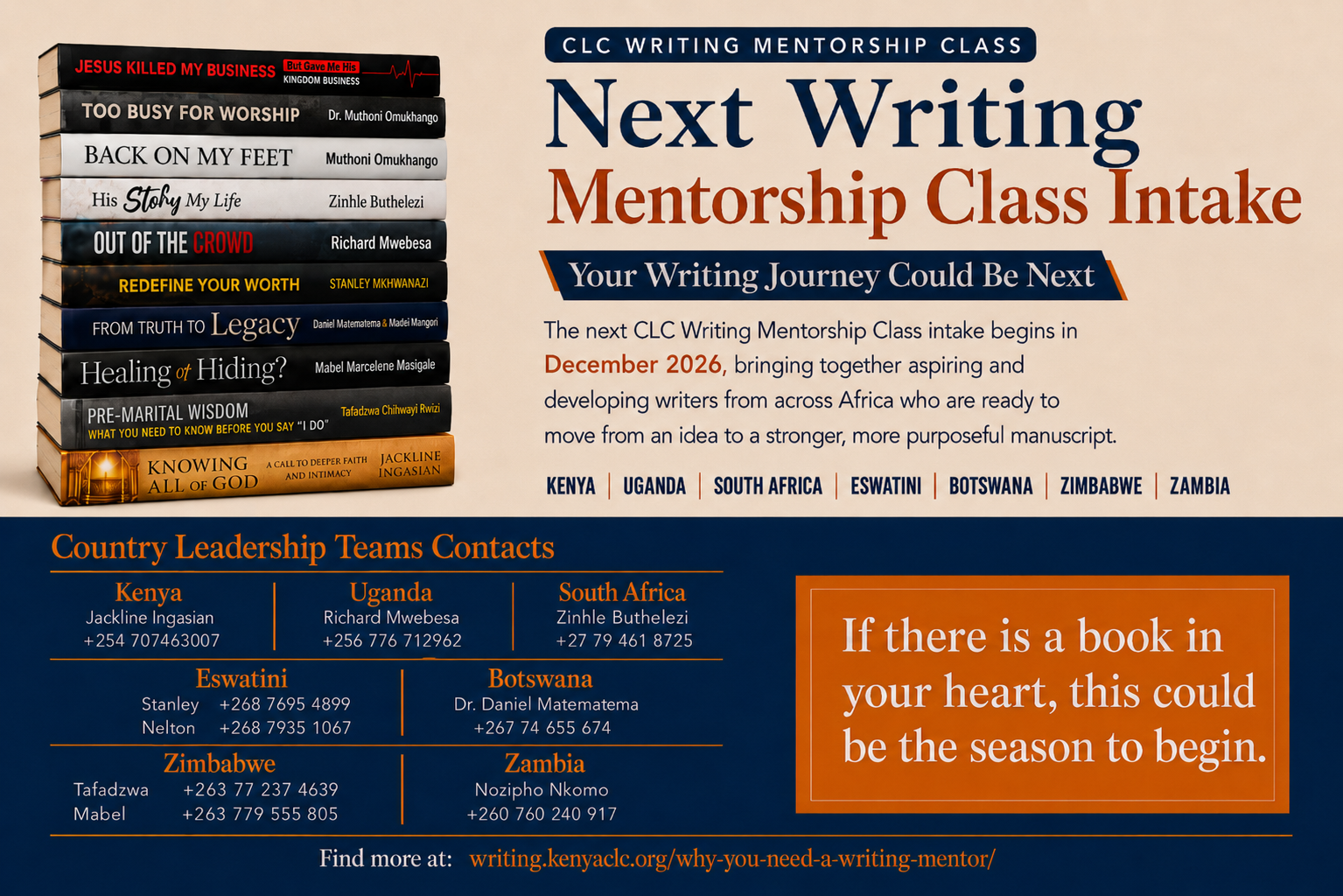
Next Writing Mentorship Class Intake
The next CLC Writing Mentorship Class brings together aspiring and developing writers who are ready to move from an idea to a stronger, purposeful manuscript.
Structured mentorship. Accountability. Constructive feedback. A clear pathway toward publishing.
“Write the vision, and make it plain…” Habakkuk 2:2Choose Your Country
Choose Your Country to Get Started
Connect directly with the Writing Mentorship Class leadership team serving your country. Tap your country below to start a WhatsApp conversation.
If there is a book in your heart,
this could be the season to begin.
Don’t leave the manuscript as an idea. Connect with the Writing Mentorship Class team in your country and take the next step toward writing, refining and publishing.
Group Writing Mentorship Class
Turn your book idea into a manuscript with structured mentorship, accountability, constructive feedback, and a clear pathway toward publishing.
CLC Kenya’s Group Writing Mentorship Class is designed to help aspiring and growing authors move from idea to manuscript, from manuscript to publishing readiness, and from publishing readiness to meaningful Kingdom impact.
Whether you are just starting with a book idea, working through a rough draft, or preparing a manuscript for publishing, this mentorship pathway provides the structure, discipline, accountability, encouragement, and guidance you need to keep writing boldly.
What You Will Learn in This Mentorship Class
Clarify your book idea, target reader, message, and manuscript direction.
Develop discipline, structure, and accountability for consistent writing.
Move from scattered ideas to chapters, sections, drafts, and manuscript flow.
Receive constructive feedback that strengthens your writing and confidence.
Understand the difference between beginner drafting and advanced manuscript refinement.
Prepare your manuscript for editing, proofreading, layout, publishing, and author growth.
✓
Module 1
Introduction to Writing Mentorship
⌄
Introduction to Writing Mentorship
Understand why writing mentorship matters, how the class works, and what kind of discipline, humility, courage, and consistency the writing journey requires.
✓
Module 2
Beginner Class: From Idea to First Draft
⌄
Beginner Class: From Idea to First Draft
Learn the foundations of writing, planning, genre awareness, storytelling, manuscript structure, chapter development, and first draft discipline.
✓
Module 3
Advanced Class: Refining Your Manuscript
⌄
Advanced Class: Refining Your Manuscript
Refine your manuscript through feedback, rewriting, editing preparation, proofreading awareness, content polishing, and publishing readiness.
✦
Module 4
Publishing Readiness and Author Development
⌄
Publishing Readiness and Author Development
Prepare for the next stage of your author journey: editing, layout, cover design, printing, book launch, visibility, distribution, and connection to wider author networks.
✦
Module 5
Graduation and Next Steps
⌄
Graduation and Next Steps
Celebrate progress, review manuscript growth, understand publishing options, and continue into post-publishing support, visibility, and author community.
Course Description
The CLC Kenya Group Writing Mentorship Class is a guided writing programme created to help aspiring and growing authors move from book idea to manuscript development, and from manuscript development to publishing readiness.
Many authors carry testimonies, teachings, devotionals, children’s stories, memoirs, ministry messages, and life lessons for years, but struggle to begin, continue, complete, or organise their writing. This course provides the structure, mentorship, accountability, feedback, and encouragement needed to help authors make steady progress.
The class is designed for both beginning writers and authors who already have a manuscript in progress. Through the beginner and advanced levels, writers are helped to clarify their message, understand their readers, shape their content, develop writing discipline, receive constructive guidance, and prepare their work for the next stage of publishing.
Who This Course Is For
Aspiring authors, ministry leaders, storytellers, devotional writers, children’s authors, Christian teachers, memoir writers, and anyone carrying a book message that needs structure and guidance.
What You Will Work On
Your book idea, writing goal, target reader, chapter structure, manuscript flow, first draft, feedback process, refinement, and preparation for publishing.
Mentorship Pathway
The mentorship pathway is designed to walk with authors step by step. The goal is not simply to talk about writing, but to help each author move forward with clarity, courage, discipline, and practical progress.
Clarify the Book Idea
Identify the message, purpose, audience, genre, and direction of the book so the author is not writing into the mist with a candle and a very brave notebook.
Build the Writing Structure
Organise the manuscript into sections, chapters, lessons, stories, or devotional entries depending on the nature of the book.
Develop the First Draft
Write consistently through guided assignments, class accountability, and practical writing milestones.
Receive Feedback and Refine
Strengthen the manuscript through constructive feedback, rewriting, editing preparation, clarity checks, and content improvement.
Prepare for Publishing
Understand the next steps after writing, including editing, proofreading, layout, cover design, printing, launch preparation, visibility, and distribution.
Continue into Author Growth
Move beyond the manuscript into post-publishing support, author visibility, reader engagement, book programmes, and connection with the wider African Christian author community.
Choose a Timeline That Works for You
You may complete the programme intensively in 13 weeks or continue through a flexible, self-paced format after the initial class period.
13-Week Intensive
Complete both levels with full commitment to weekly assignments, group sessions, feedback, writing discipline, and consistent manuscript development.
Self-Paced Options
Continue at a flexible pace using explainer videos and resources after the intensive phase.
After the 13-week period, the course transitions into a self-paced format with explainer videos and resources. There will be no weekly face-to-face mentorship after the initial 13 weeks, but learners retain access to course materials.
Your Commitment, Your Success
Your engagement and investment in this writing class will shape the quality and success of your manuscript.
Time Commitment
Commit time to write regularly, complete assignments, and meet deadlines.
Meeting Attendance
Participate in online and in-person meetings for guidance, fellowship, and networking.
Step-by-Step Approach
Follow the class in order so each phase builds toward a draft manuscript.
Financial Investment
KES 18,000 subsidised rate, reduced from the standard fee of KES 45,000.
How Writing Mentorship at CLC Kenya Will Benefit You
Learn how mentorship provides inspiration, honest feedback, professional development, accountability, and emotional support.
CLC Kenya Group Writing Class Requirements
Understand the time commitment, meeting attendance, step-by-step structure, and financial investment needed for the class.
Knowledge & Skills You Will Learn
Your Book Is Waiting to Be Written
Do not let fear, uncertainty, or lack of structure hold you back. Join CLC Kenya’s Group Writing Class and take the next faithful step toward completing your manuscript.
Mentorship, Structure, Accountability and Publishing Readiness
Expert Guidance
Receive mentorship from experienced writing professionals who provide support, direction, and feedback.
Structured Learning
Follow a clear roadmap to develop your manuscript from idea to polished final draft.
Accountability
Stay focused, meet writing goals, submit assignments, and keep progressing even when the journey gets tough.
Constructive Feedback
Receive helpful critique that strengthens your manuscript, improves your craft, and builds resilience.
Professional Development
Understand writing, publishing, content distribution, and the realities of becoming a published author.
Ongoing Support
Grow in a supportive environment where affirmation and correction work together to help you complete your book.
Ideas are not enough. Guidance matters.
Many writers do not fail because they lack ideas. They fail because they lack structure, accountability, feedback, discipline, and guidance. A book may begin as a powerful burden, testimony, revelation, lesson, story, or message, but without the right support, it can remain scattered in notebooks, voice notes, documents, or unfinished chapters.
With guidance, encouragement, correction, and accountability, the message God has placed in the writer’s heart can be shaped into a book that is clear, purposeful, and ready to serve readers.
Explore the Writing Mentorship Class →Introduction to Writing Mentorship
Understand why writing mentorship matters, how the class works, and what kind of discipline, humility, courage, and consistency the writing journey requires.
About the Writing Mentorship Journey
This writing mentorship class walks authors through the full writing process: understanding their purpose, preparing their ideas, drafting the manuscript, strengthening storytelling, handling genre expectations, receiving feedback, revising the work, and preparing for the publishing phase.
Why Are You Here? + Introduction
This introductory session helps writers examine their motivation for writing. It lays the foundation for purpose-driven authorship by asking the writer to clarify their calling, audience, message, expectations, and commitment to the writing journey.
Watch Lesson Video One
Watch Lesson Video Two
Beginner Class: From Idea to First Draft
Learn the foundations of writing, planning, genre awareness, storytelling, manuscript structure, chapter development, and first draft discipline.
Pre-Writing
Writers are guided to organise their thoughts, define their book concept, identify their readers, outline their message, and prepare a strong writing framework before drafting.
Watch Lesson Video
Warm Up Writing
This session helps writers overcome fear, hesitation, and the pressure to write perfectly, introducing practical exercises that help the writer begin producing words consistently.
Watch Lesson Video
Actual Drafting
Writers move from preparation into actual manuscript development, learning how to begin, maintain momentum, manage raw ideas, and avoid premature editing.
Watch Lesson Video
A Message from Your Unborn Book
This encouragement session reminds authors that unfinished books carry value and may be waiting to bless, teach, comfort, correct, or inspire someone.
Watch Lesson Video
The First Three Chapters
Writers learn how to begin strongly, introduce their subject, establish reader interest, build trust, and set the direction for the rest of the manuscript.
Watch Lesson Video
The Marathon: Fatigue of the Middle
This session addresses the difficult middle stage of writing and teaches writers how to push through fatigue, maintain structure, revisit purpose, and continue writing.
Watch Lesson Video
The Six Types of Conflict
Writers learn how internal, relational, social, spiritual, environmental, and situational conflict can deepen storytelling and reader engagement.
Watch Lesson Video
The Art of Storytelling
Writers learn how to use scenes, characters, testimony, memory, emotion, tension, and resolution to make their message memorable and meaningful.
Watch Lesson Video
Formatting and Genre Technicalities
This stage helps authors understand how genre shapes structure, language, reader expectations, and manuscript development.
Non-Fiction Writing
Guides non-fiction authors on how to organise ideas clearly, develop chapters logically, support the message with examples, and maintain a helpful balance between teaching, testimony, research, and reflection.
Watch Lesson Video
Children’s Books
Covers age-appropriate language, simple but meaningful themes, child-friendly structure, imagination, illustrations, moral formation, and respect for the child reader.
Watch Lesson Video
Autobiography
Helps writers shape personal life stories into meaningful manuscripts, with attention to memory, honesty, structure, testimony, privacy, family sensitivity, and service to others.
Watch Lesson Video
How to Write a Book’s Conclusion Chapter
This resource helps writers close their books well by bringing the message together, reminding the reader of the journey, and ending with clarity, hope, and purpose.
Read Conclusion GuideAdvanced Class: Refining Your Manuscript
Refine your manuscript through feedback, rewriting, editing preparation, proofreading awareness, content polishing, and publishing readiness.
Formatting & Proofreading
Writers learn the discipline of preparing a clean manuscript, with focus on formatting consistency, readability, paragraph flow, grammar, spelling, punctuation, and professional presentation.
Watch Lesson Video
Incorporating Review Feedback
Writers learn how to receive feedback without discouragement and apply it wisely, separating personal emotion from editorial improvement.
Watch Lesson Video
Book Reviews — Peer & Mentor
This week focuses on peer and mentor review, helping writers give helpful feedback, receive constructive comments, identify manuscript gaps, and sharpen one another.
Watch Lesson Video
Revising, Editing & Proofreading
Writers go deeper into manuscript refinement through revision for structure, editing for clarity, proofreading for accuracy, and preparation for the next publishing stage.
Watch Lesson Video
Formatting & Proofreading
Preparing a Clean, Consistent and Professional Manuscript
Learn the discipline of preparing a manuscript that is readable, consistent and ready for editorial review, layout and publishing. This practical session focuses on formatting, paragraph flow, grammar, spelling, punctuation and professional presentation.
Student Details
Enter your details before beginning. Your name will appear on the certificate after you complete the practical session.
Session Overview
Good writing deserves a clean and professional presentation.
A strong message may be weakened by inconsistent formatting, careless punctuation, spelling mistakes, overcrowded paragraphs or confusing sentence structure. A clean manuscript helps editors, designers, publishers and readers focus on the message rather than being distracted by avoidable errors.
Self-editing does not replace professional editing. It prepares the manuscript for professional editing. The writer takes responsibility for correcting obvious errors, improving readability and presenting the manuscript in an orderly form.
Learning Outcomes
By the end of this practical session, you should be able to:
- apply consistent manuscript formatting;
- recognise formatting choices that reduce readability;
- improve paragraph organisation and flow;
- identify common grammar, spelling and punctuation errors;
- proofread a short manuscript extract;
- use a manuscript-submission checklist; and
- prepare a personal proofreading plan.
Consistency
Headings, fonts, paragraph spacing, numbering and other elements should follow the same pattern throughout the manuscript.
Readability
The manuscript should be easy to follow, with sensible paragraph breaks, clear sentences and enough visual space.
Accuracy
Grammar, spelling, punctuation and word usage should communicate the author’s intended meaning correctly.
Training Video
Introduce the practical principles before beginning the exercises.
Video Coming Soon
Formatting and Proofreading: Preparing a Clean Manuscript for Editorial Review and Publishing
Replace this placeholder with the final YouTube or Vimeo embed when the training video is ready.
Additional Reading Resource
Read why every writer should self-edit a manuscript before submitting it for publishing.
Resource Reflection
Practical ActivityFormatting Consistency
A clean manuscript should look orderly before professional design begins.
Manuscript formatting is not the same as final book design. The author does not need to decorate the manuscript or attempt to produce the finished book layout. The purpose is to present the content in a clear, simple and consistent form.
Recommended Manuscript Formatting
CHAPTER one
Becoming A Better Writer
Writing is an important calling. A writer should therefore take time to prepare there manuscript properly before publishing.It should look clean and be easy to read.
Chapter One
Becoming a Better Writer
Writing is an important calling. A writer should therefore take time to prepare their manuscript properly before publishing. It should look clean and be easy to read.
Practical Exercise: Identify the Formatting Problems
Required ActivityReview the inconsistent example above and list at least five formatting or presentation problems.
0/1,000 charactersYour Manuscript Formatting Standard
Practical ActivityParagraph Flow and Readability
Paragraphs should organise the message and guide the reader.
A paragraph should generally develop one main idea. A new paragraph should begin when the writer introduces a new idea, changes speaker, changes time or location, or shifts the direction of the discussion.
Very long paragraphs may overwhelm the reader. Very short and disconnected paragraphs may make the writing feel hurried or fragmented. The goal is not to make every paragraph the same length, but to make each paragraph purposeful.
Practical Exercise: Improve the Paragraph Flow
Required ActivityThe passage below contains several ideas in one long paragraph. Rewrite it using suitable paragraph breaks and improved sentence flow.
Paragraph Review Questions
Self-ReviewGrammar, Spelling and Punctuation
Proofreading requires slow, deliberate and careful reading.
Proofreading is the final close review of a manuscript for surface errors. It focuses on issues such as spelling, punctuation, capitalisation, missing words, repeated words, incorrect word forms and minor grammatical mistakes.
Proofreading is most effective after the larger issues of content, structure and paragraph organisation have already been addressed. There is little benefit in polishing a sentence that may later be deleted or rewritten entirely.
- Check subject–verb agreement.
- Check verb tense consistency.
- Correct incomplete sentences.
- Correct run-on sentences.
- Check pronoun agreement and clarity.
- Remove unnecessary or repeated words.
- Check commonly confused words.
- Check names, places and specialised terms.
- Check compound words and hyphenation.
- Do not rely entirely on the computer spell-checker; it may accept a correctly spelt but incorrectly used word.
- Maintain British or American spelling consistently unless quoting another source.
- Check full stops at the end of sentences.
- Use commas where they clarify meaning.
- Check apostrophes in contractions and possession.
- Check quotation marks and dialogue punctuation.
- Avoid overusing exclamation marks.
- Ensure brackets, dashes and colons are used correctly.
- Capitalise the first word of every sentence.
- Capitalise proper nouns and official names.
- Check chapter and heading capitalisation.
- Apply the chosen approach to divine-pronoun capitalisation consistently.
- Avoid using full capital letters merely to create emphasis.
Practical Exercise: Proofread the Passage
Required ActivityRewrite the passage below. Correct the grammar, spelling, punctuation, capitalisation and paragraphing.
Many writers believe that editing is only the publisher’s work. However, an author should review their manuscript before submitting it. This helps the editor to focus on deeper issues instead of spending all their time correcting simple mistakes.
A clean manuscript also communicates respect for the reader and the publishing team. It shows that the writer has taken the assignment seriously.
Writers should therefore read their work slowly, use a dictionary when necessary and ask another trusted person to read it too.
Error-Finding Challenge
Knowledge PracticeWhich problems appear in this sentence?
Preparing a Clean Manuscript
Complete a final review before submitting your work.
A manuscript may be considered clean when it is orderly, complete, readable and free from obvious errors that the author could reasonably have corrected before submission.
Manuscript Submission Checklist
Create a Professional File Name
Required ActivityAvoid file names such as My Book Latest Final Final 4.docx. Use a name that clearly identifies the author, book and version.
Your Current Manuscript Review
Required ActivityPractical Session Assessment
A score of at least 80% is required to complete the session.
Your Manuscript Preparation Plan
Decide how you will format, review and proofread your manuscript.
Complete the Practical Session
Finish the required activities, achieve at least 80% in the assessment and generate your manuscript-preparation plan.
Formatting & Proofreading
This certificate is awarded to
for successfully completing the practical session
Completed on
Christian Writers’ Training
Publishing Readiness and Author Development
Prepare for the next stage of your author journey: editing, layout, cover design, printing, book launch, visibility, distribution, and connection to wider author networks.
Welcome to the Publishing Phase
This session introduces writers to the publishing phase. It explains what happens after writing: editorial preparation, publishing decisions, production steps, author responsibility, and the transition from manuscript to book.
Watch Lesson Video
Graduation and Next Steps
Celebrate progress, review manuscript growth, understand publishing options, and continue into post-publishing support, visibility, and author community.
Graduation Preparation
Authors reflect on their progress, finalise pending class requirements, prepare their presentations, and celebrate the discipline of bringing their book project this far.
Graduation
Graduation marks the completion of the writing mentorship class. It honours the authors’ commitment, celebrates completed or developing manuscripts, and commissions writers into the next phase of authorship, publishing, and impact.
From Idea to Manuscript, From Manuscript to Impact
This mentorship journey is designed to help writers steward their God-given messages with clarity, courage, discipline, and excellence.
Authors Academy: Choose the Support You Need for Your Author Journey
Every author needs the right guidance at the right stage. Whether you are preparing your manuscript, navigating what happens after publication, or learning how to market and distribute your book, these resource hubs are designed to help you move with clarity, excellence, wisdom, and purpose.
Publishing in Africa: Writing & Publishing Guides
A practical publishing resource hub for African Christian authors who desire to prepare, write, refine, publish, market, and distribute their books with excellence, wisdom, and purpose.
Go to Authors AcademyAbout This Publishing Resource
Publishing a book is more than printing pages and placing a cover on a manuscript. It is a stewardship journey that begins with preparation, continues through writing and editing, and matures into distribution, visibility, reader engagement, and long-term impact.
This page brings together publishing articles designed to equip African authors at every stage: from the first decision to publish, to manuscript structure, book elements, legal awareness, publishing agreements, design, layout, pricing, book marketing, and life beyond the book launch.
Post-Publishing Guides
Welcome to the next chapter of your author journey. Our Post-Publishing Support equips African Christian authors with book launches, visibility programmes, eCommerce and eBook distribution, certification, and reading communities.
Go to Authors AcademyAuthor Training & Support Hub
Navigate through each stage of your publishing and post-publishing journey with clarity, order, and purpose. Your book is now published. Congratulations, Author! You have done the hard work. Now it is time to make your book known, accessible, protected, celebrated, and positioned for lasting Kingdom impact.
At CLC Kenya, we walk with you from printing to platform building. You are on Step 03 of an Author’s Journey.
Marketing & Distribution Guides
An author’s life beyond the book launch includes visibility, sales, reviews, consistency, prayer, community, events, and long-term readership.
Go to Authors AcademyLife Beyond the Book Launch
Publishing your book is a major milestone, but it is not the end of the journey. Once the book is released, the author must continue stewarding the message through visibility, reader engagement, bookselling, reviews, pricing, community, and consistent communication.
This post-publishing knowledge base helps authors understand the practical work needed after publication so that the book does not merely exist, but continues to reach readers, open doors, and create Kingdom impact.
Continental Partnerships, Kingdom Stories
Across Africa, partner organisations are helping writers discover their voices, complete manuscripts, and step into the publishing journey with courage, clarity, and purpose.
Arise and Shine Heirs
“Running the third writing mentorship class for South Africa has shown us that Christian authorship is not just a programme — it is a movement of voices being awakened, strengthened, and prepared for Kingdom impact.”
Nairobi Pentecostal Bible College
“Seeing lecturers graduate with manuscripts is building the leadership capacity that we stand for at NPBC. This partnership is helping Christian leaders move from knowledge held within them to written resources that can serve the Church and society.”
Kabubbu Development Project
“We have seen two writing classes take shape — one for primary school learners and another for high school students. Watching children move from ideas to completed books has been a powerful reminder that young voices also carry messages worth publishing.”
Chariots For Hope
“Seeing 11 children getting published in 2026 is a dream come true. These young writers are not only gaining confidence; they are discovering that their stories, faith, imagination, and lived experiences can bless many readers.”
Mind Food and Soul Organisation
“Running our first writing mentorship class in 2026 has opened a new door for Christian writers in Eswatini. Writers graduated with stronger manuscripts and are now moving towards publishing with greater confidence and direction.”
Writing Hub
“Running our first writing mentorship class in 2026 marks the beginning of something significant for Botswana. We are excited to help writers grow from book ideas into completed manuscripts that can serve readers across Africa and beyond.”
Arise and Shine Heirs
“Running the third writing mentorship class for South Africa has shown us that Christian authorship is not just a programme — it is a movement of voices being awakened, strengthened, and prepared for Kingdom impact.”
Nairobi Pentecostal Bible College
“Seeing lecturers graduate with manuscripts is building the leadership capacity that we stand for at NPBC. This partnership is helping Christian leaders move from knowledge held within them to written resources that can serve the Church and society.”
Kabubbu Development Project
“We have seen two writing classes take shape — one for primary school learners and another for high school students. Watching children move from ideas to completed books has been a powerful reminder that young voices also carry messages worth publishing.”
Chariots For Hope
“Seeing 11 children getting published in 2026 is a dream come true. These young writers are not only gaining confidence; they are discovering that their stories, faith, imagination, and lived experiences can bless many readers.”
Mind Food and Soul Organisation
“Running our first writing mentorship class in 2026 has opened a new door for Christian writers in Eswatini. Writers graduated with stronger manuscripts and are now moving towards publishing with greater confidence and direction.”
Writing Hub
“Running our first writing mentorship class in 2026 marks the beginning of something significant for Botswana. We are excited to help writers grow from book ideas into completed manuscripts that can serve readers across Africa and beyond.”
Bring Your Country Into a Continental Writing Movement
Join CLC Kenya in raising Christian authors across Africa. Partner with us to host a Group Writing Mentorship Class in your city, ministry, church, school, or organisation and help impact lives with Christian literature from Africa to Africa and beyond.